Land type · Solar, wind & hybrid
Solar and renewable energy land in Kutch
Kutch hosts India’s largest renewable build-out, the Khavda hybrid renewable energy park — but that park is government land leased to developers and cannot be bought. Private land enters the picture around it: contractor and storage yards along NH 341, projects close to the Bhuj and Lakadia 765 kV substations, and captive solar for factories. In western Kutch, a Supreme Court order of 19 December 2025 bars new wind turbines and solar plants above 2 MW inside a 740 sq km Great Indian Bustard priority area, so every parcel there must be checked against it first.
Facts last reviewed on
Khavda: the park that shapes the market but is not part of it
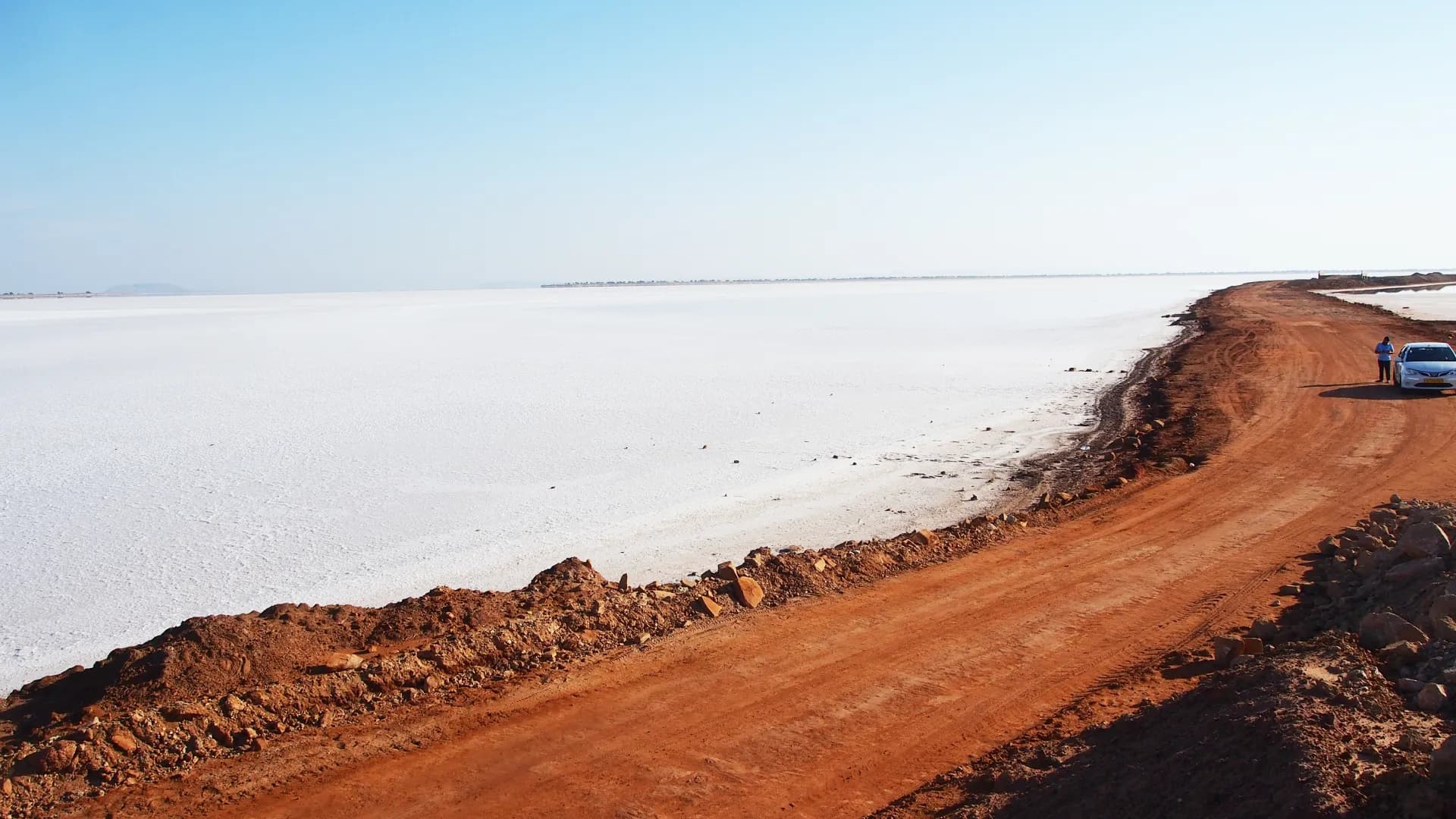
The Gujarat Hybrid Renewable Energy Park near Khavda, approved by the State in September 2020, is planned for 30 GW of solar and wind on a vast tract of the Great Rann — reported as somewhere between about 540 and 730 sq km. Adani Green Energy holds the largest share and had about 10 GW operating there by September 2026; NTPC REL, GSECL, GIPCL and a SECI wind zone hold other blocks. The outer edge is about 1 km from the international border, and civilian movement beyond India Bridge needs BSF permission.
Offers of “land inside Khavda park” should be treated with suspicion
The park is government land allotted on lease to developers. It is not available for private purchase, and the border setting adds further restrictions. Any private offer claiming to be inside the park needs its 7/12 checked on AnyROR before anything else.What the park does create is demand for private land along the Bhuj–Khavda stretch of NH 341: contractor yards and laydown areas, module and balance-of-system storage, labour camps and staff housing, and O&M, fuel and vehicle-service bases. Most of that sits on NA land between Bhuj and Khavda — see land in Bhuj.
Khavda village, Pachham and the distance to the park
A common mistake is to picture the park on the edge of Khavda village. Khavda is a Bhuj-taluka village of about 4,062 people (Census 2011), PIN 370510, on the west side of Pachham island in the Great Rann, about 70 km from Bhuj on NH 341. The park that carries its name lies roughly 80 km further on, towards the border, and NHPC gives the distance from the park to Bhuj — its nearest railhead and airport — as about 110 km.
| From – to | Approx. distance |
|---|---|
| Bhuj – Khavda village (NH 341) | About 70 km |
| Khavda village – park site | About 80 km (reported) |
| Bhuj – Khavda RE park | About 110 km (NHPC) |
| Khavda – Dholavira (NH 754K across the Rann) | About 30 km |
Much of the park’s own demand is met inside its boundary. Reports from 2024 describe the government leasing Adani’s site for 40 years, accommodation for about 8,000 workers being built within it, and around 100 km of internal roads already laid. Other developers are still building: NHPC’s 600 MW Stage II project there targets commercial operation in September 2027, connected by a 400 kV line of about 15 km to the KPS-III pooling station.
So private-land demand in the hinterland is narrower than the park’s size suggests. Our reading — not a sourced market figure — is that it centres on Khavda village itself and on NH 341 towards Bhuj, for vehicle and equipment yards, fuel and repair services and small lodging. Pachham’s larger villages include Dhrobana (about 8,098) and Kuran (about 1,437). Border-area permissions apply around here, so confirm with the Collector before committing, and check records on AnyROR.
The Great Indian Bustard ruling and western Kutch
The grasslands around Naliya in Abdasa are the only place in Gujarat where the Great Indian Bustard is still found, and only a handful of birds remain. On 19 December 2025 the Supreme Court replaced its 2021 blanket order with “revised priority areas” — 740 sq km in Gujarat. Inside a priority area:
- no new overhead power lines, except local distribution at 11 kV and below;
- no new wind turbines;
- no new solar plants above 2 MW, and no expansion of existing renewable projects;
- specified existing 33/66 kV and higher lines in Gujarat to be undergrounded or rerouted, with timelines up to 2028;
- future high-voltage lines to use dedicated corridors.
In January 2026 the Ministry of Power classified approval delays for transmission lines in bustard zones as force majeure, which eases contractual pressure on projects already caught by the ruling but does not lift the restrictions.
Village-level boundaries are not public in a usable form
We have not been able to obtain a village or survey-number map of Gujarat’s 740 sq km priority area. Do not rely on anyone’s verbal assurance that a parcel in Abdasa, Nakhatrana or nearby is “outside the GIB zone” — check it against the judgment’s annexure or with the Forest Department. See land in Abdasa.Where the transmission capacity is
For a renewable project of any size, the distance to a substation with spare capacity matters more than the land itself. In Kutch, the high-voltage grid is converging on two hubs:
| Line or substation | Status | Land market it affects |
|---|---|---|
| Khavda–Bhuj 765 kV double circuit to Bhuj Pooling Station | Completed January 2024 | Bhuj taluka |
| Khavda (KPS2)–Lakadia 765 kV | Completed by March 2025 | Bhachau taluka |
| Lakadia–Vadodara 765 kV (335 km) | Commissioned 2023 | Evacuation from Kutch to the mainland |
| Lakadia-II 765/400 kV substation, 7.5 GW evacuation (POWERGRID) | Letter of intent September 2026 | Bhachau and Rapar |
| Further KPS1–Bhuj and KPS3–Lakadia lines | Targeted 2026 to March 2027 | Bhuj and Bhachau |
This is why Bhachau and Rapar, in eastern Kutch and outside the bustard area, attract renewable enquiries. Grid connection for an individual project is still a separate approval; proximity to a substation is not the same as allocated capacity. See land in Bhachau and land in Rapar.
Four ways private land is used in Kutch’s energy transition
| Use | Where | Land needed |
|---|---|---|
| Support yards for Khavda | NH 341 between Bhuj and Khavda | NA land with road access and storage space |
| Grid-connected solar or hybrid outside the park | Eastern Kutch near Lakadia; western Kutch only outside the bustard area | Large contiguous parcels with clear title |
| Captive solar for a factory | Next to or near the plant — for example, a 3 MW captive plant at Moda, Rapar taluka, built in 2026 for a Bhachau starch unit | Smaller parcels, often adjoining industrial land |
| Renewable equipment and green-fuel manufacturing | Mundra (solar module manufacturing) and Kandla (port land allotted for green hydrogen and ammonia) | Industrial land — see industrial land in Kutch |
Interest is likely to continue: at the January 2026 Vibrant Gujarat regional conference, Kutch drew renewable-energy MoUs including an NLC India pledge and a KP Group pledge for about 855 MW of solar and hybrid capacity, and the Viksit Gujarat Industrial Policy 2026 treats renewable equipment, battery storage and green hydrogen as thrust sectors. MoUs are intentions, not land purchases.
Ground and location conditions specific to Kutch
- Rann-edge land is saline and floods in the monsoon; check how a site behaved in recent monsoons before planning mounting structures and access roads.
- Sanctuaries: the Wild Ass Sanctuary, Kutch Desert Wildlife Sanctuary and Narayan Sarovar Sanctuary cover large areas. A permission under the tenancy law does not replace wildlife clearance where a parcel falls inside or next to one.
- Border areas: land near Khavda, Lakhpat and the international border can need security clearances and, in places, visitor permits; check with the Collector before committing.
- Earthquake and cyclone: all of Kutch is Seismic Zone V, and the western coast took Cyclone Biparjoy’s landfall near Jakhau in June 2023 — relevant to structure and module-mounting design.
- Grazing land: gauchar is common land and cannot be bought, and encroachment on it is a common issue in Kutch — confirm boundaries with a DILR measurement.
Leasing or selling your land to a renewable developer
Landowners often ask whether to lease or sell. We do not publish lease rents or sale values, but the legal points that apply either way are clear:
- 1
A lease is caught by the tenancy law too
Section 89 of the Kutch tenancy Act restricts not only sale but also gift and lease of agricultural land to a non-agriculturist without the Collector’s permission. A long lease to a company is not a way around the farmer rule.
- 2
Confirm the developer’s legal route
Whether a particular project can buy or lease under Section 89A or needs another permission is a question for the Collector and the developer’s counsel. Ask the developer which route it is using before you sign.
- 3
Expect a non-agricultural use permission
A solar plant is a non-farm use; the land will normally need NA permission or the equivalent. See the NA conversion guide.
- 4
Clean records first
Developers’ lenders insist on clean title: updated 7/12 and 8A, all co-owners and heirs joined, bank charges removed. Our title check guide lists what they look for.
- 5
Think about the tax
Selling agricultural land, and converting it before sale, have different tax outcomes — read tax on selling land.
If you own a large parcel near Lakadia, along NH 341 or elsewhere in Kutch and want to explore a sale, share the details with us. We will check where it sits against the constraints above before putting it in front of developers.
Frequently asked questions
Is any land inside the Khavda park open to private buyers?
No. The park is government land leased to developers such as Adani Green Energy, NTPC REL, GSECL and GIPCL. Private demand around Khavda is for support yards and housing on NA land along NH 341.
How far is the Khavda park from Khavda village and from Bhuj?
Khavda village is about 70 km from Bhuj on NH 341, and reports put the park site about 80 km beyond the village. NHPC gives the park’s distance to Bhuj, the nearest railhead and airport, as about 110 km.
Can I put up a solar plant near Naliya?
Only after checking the Great Indian Bustard priority area. Inside Gujarat’s 740 sq km priority area, the Supreme Court’s December 2025 order bars new solar plants above 2 MW, new wind turbines and most new overhead lines.
Why are Bhachau and Rapar popular for solar enquiries?
They lie in eastern Kutch, away from the bustard area, near the Lakadia 765/400 kV substation, where a second Lakadia-II substation for 7.5 GW of evacuation was awarded in 2026.
Can a farmer lease land to a solar company in Kutch?
Not freely. Section 89 of the Kutch tenancy Act restricts leasing agricultural land to a non-agriculturist without the Collector’s permission, just as it restricts sale. Confirm the developer’s legal route before signing.
Does the green hydrogen cluster at Kandla need private land?
The main allotments — about 3,400 acres to four companies — are on Deendayal Port Authority land. Private demand is more likely for ancillary and supply-chain units on industrial land nearby.
Related pages
Locations
Bhachau & Samakhiyali
Kutch’s gateway taluka — the NH 27/NH 41 junction, freight rail, 765 kV grid hubs and salt-creek land.
Locations
Rapar (Vagad)
Kutch’s largest Narmada-command farm taluka, with solar parcels and NH 27 frontage at Chitrod and Adesar.
Locations
Abdasa & Lakhpat
Naliya, Jakhau and Lakhpat — farmland, cement and lignite land, checked first against the 2025 bustard ruling.
Locations
Bhuj & Madhapar
District headquarters — BHADA-zoned city plots, NRI-driven Madhapar and project land on the Khavda road.
Guide
Industrial land
Seven industrial belts compared, plus the three legal routes to an industrial site in Kutch.
Guide
Sell your land
Industrial, NA, commercial or farm land to sell? See how we review records and reach matched buyers.
Buying or selling land in Kutch?
Tell us what you need. We work with landowners, brokers and industrial buyers across every taluka of Kutch.